Prado de Lácara dolmen
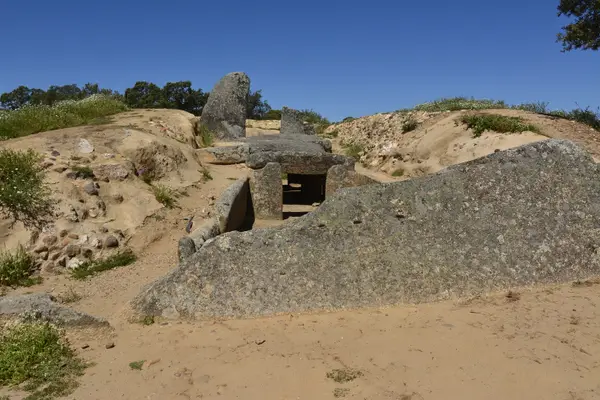
The Prado de Lácara dolmen is a megalithic passage grave in the municipality of La Nava de Santiago (Badajoz), some 25 km north-west of Mérida. It is the largest passage grave recorded in Extremadura and one of the most monumental in the Iberian Peninsula.
- Type
- Dolmen
- Preservation
- Standing
- Protection
- Listed · RI-51-0000106
- Coordinates
- 39.04983, -6.42089
- Photographs
- 14
What it is and what is left
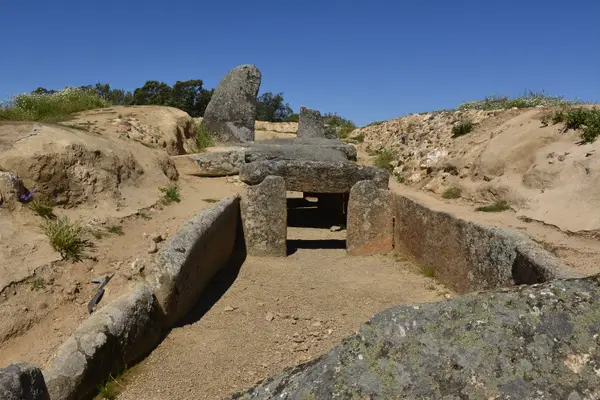
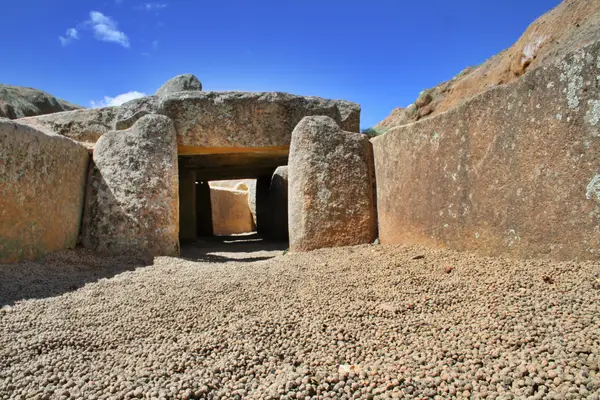
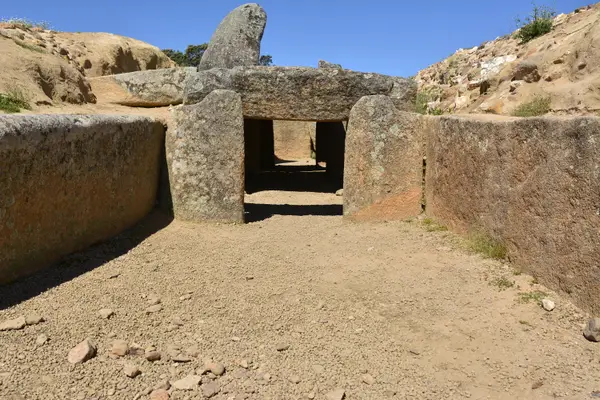
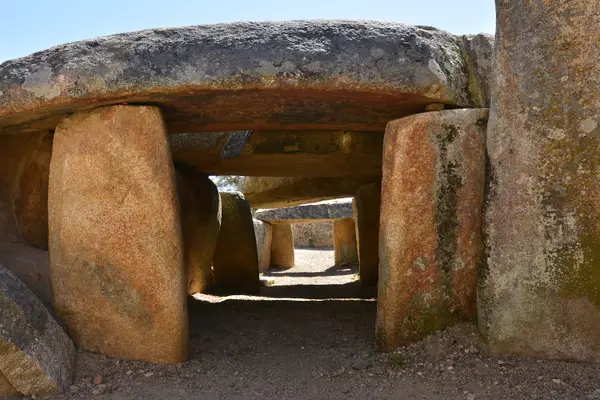
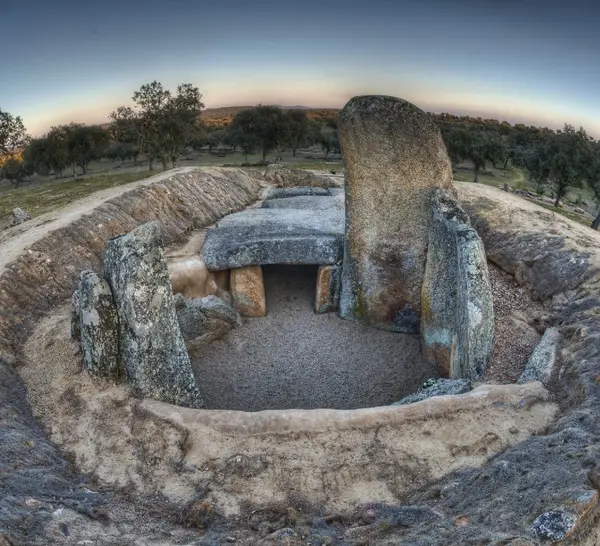
The structure has three parts: an outer forecourt, an antechamber and a circular burial chamber about 5 metres across and 5.2 metres high, formed of seven granite orthostats. The entrance passage is more than 20 metres long and runs east–west. The barrow that covered the whole reaches some 28-35 metres in diameter and still stands 3.5 metres high.
It was built towards the end of the 4th millennium BC or the beginning of the 3rd (late Neolithic), and reused for burial through the Copper Age and the Bronze Age. Martín Almagro Basch's excavations in 1957-1958 recovered a varied assemblage: arrowheads, flint knives and axes, two copper heads, necklace beads, a slate plaque-idol with incised decoration, and abundant red ochre used in ritual.
Declared a national monument in 1931, it has suffered looting and was used as a dwelling and a quarry in Roman and medieval times. In 2011 it was restored and presented to the public by the regional government of Extremadura.
What each period left here
It reads downwards: each band is a period with fabric in this site, newest first, deepest last.
0 facts
0 photographs
Copper Age
This site has fabric from this period. Mérida has 1 more sites built in the same layer.
See the whole layer →2 facts
1 photographs
Neolithic
This site has fabric from this period. Mérida has 1 more sites built in the same layer.
See the whole layer →In the late 19th or early 20th century somebody blew the chamber's capstone off with dynamite: the dolmen was being used as a stone quarry.
Dolmen del prado de Lácara — WikipediaThe proof of the looting is carved into the stone: the slabs covering the passage still bear the wedge marks from when the dolmen was used as a quarry.
Algo más que huesos — El dolmen de Lácara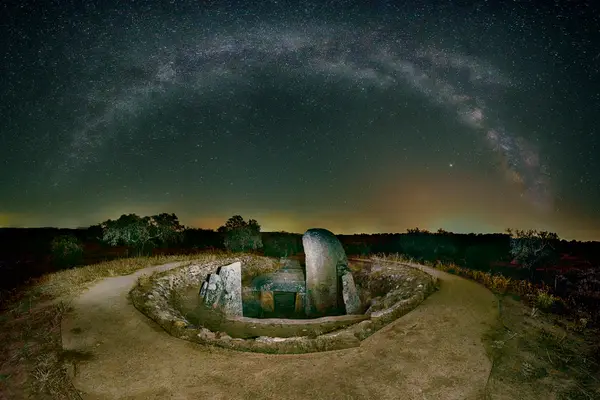
Below the deepest layer of each site is the ground itself: what has not been excavated yet, or what left nothing built. The catalogue only claims what is documented.
What is told about this site
Before it was a monument it was a house and a pen: for years it served as a dwelling and as shelter for livestock, and it keeps traces of Roman and medieval domestic use, with tegulae and pottery among the finds.
Dolmen del prado de Lácara — WikipediaIt was declared a national monument on 3 June 1931, a few weeks after the Second Republic was proclaimed.
Dolmen del prado de Lácara — WikipediaBy the time Almagro Basch excavated, the tomb had already been robbed: what was recovered are the leftovers of earlier plundering. Even so, knives, arrowheads and slate plaques came out.
Algo más que huesos — El dolmen de LácaraAmong the grave goods is a plaque-idol of dark grey slate, engraved on one face, with pierced eyes and geometric decoration, and a fragment of a Bell Beaker vessel.
Algo más que huesos — El dolmen de LácaraThe monument has been drawing attention since the 19th century: the first to come and study it was Barrantes, in 1875, and Almagro Basch did not publish his major paper until 1959.
Emerita Expeditiones — La dehesa del Prado de LácaraPhotographs
A short walk from here
Straight-line distances, worked out from the coordinates of each site.
Where this page comes from
- Ficha en Vici.org vici.org
- Dolmen del prado de Lácara — Wikipedia en.wikipedia.org
- Dolmen de Lácara — Consorcio Ciudad Monumental de Mérida consorciomerida.org
- Dolmen de Lácara, Arte Megalítico — Turismo Extremadura turismoextremadura.com