Roman wall and Albarrana tower
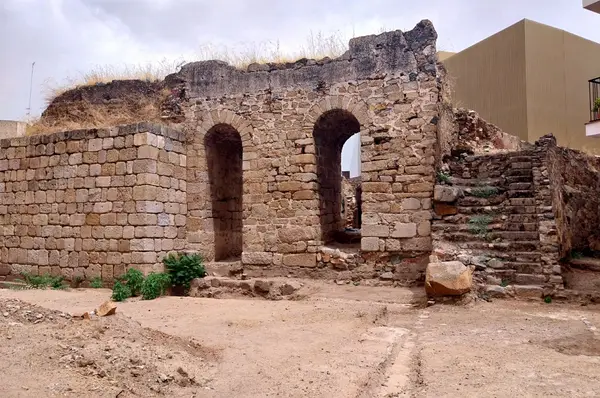
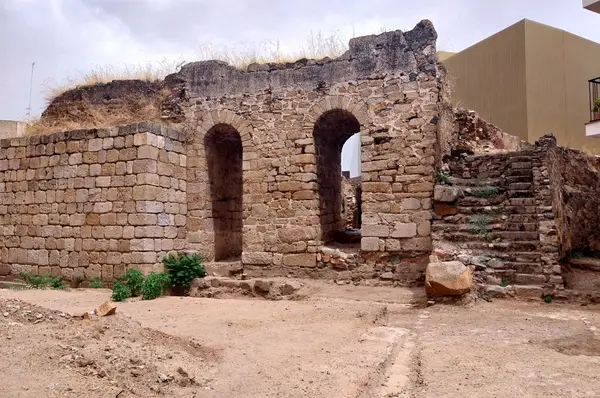
A stretch of the Roman wall of Augusta Emerita preserved in the town centre of Mérida, on which stands the so-called Torre Albarrana, an Islamic tower of the al-Andalus period (10th–11th centuries). The founding wall of the Roman colony was built around 25 BC, when the city was founded to settle the veterans of the legions V Alaudae and X Gemina. It had a perimeter of almost 3,800 metres, a thickness of 2.80 m and a height of between 6 and 8 m, with gates flanked by rectangular towers where the main streets met it. In the 5th century AD it was altered by the addition of an outer wall of reused material (granite ashlars, cupae and column shafts).
- Type
- City wall
- Preservation
- Ruined
- Protection
- Listed · RI-53-0000148
- Listed
- 08/02/1973
- Coordinates
- 38.91944, -6.34406
- Photographs
- 2
What it is and what is left
On the remains of the Roman wall an albarrana tower of the Umayyad-taifa period was raised, standing free and originally linked to the medieval circuit. It was bought by Mérida town council in 2020 to bring it into the María Luisa Theatre project. In 2024 the Consorcio de la Ciudad Monumental excavated around it to document the course of the Roman wall beneath and establish the date of the whole, with a view to creating a new square and entrance to the theatre.
The complex is an exceptional stratigraphic record of the layering of cultures — Roman, Visigothic, Islamic — in Augusta Emerita, a city declared a UNESCO World Heritage site in 1993.
What each period left here
It reads downwards: each band is a period with fabric in this site, newest first, deepest last.
0 facts
0 photographs
Islamic (al-Andalus)
This site has fabric from this period. Mérida has 4 more sites built in the same layer.
See the whole layer →0 facts
0 photographs
Roman
This site has fabric from this period. Mérida has 57 more sites built in the same layer.
See the whole layer →Below the deepest layer of each site is the ground itself: what has not been excavated yet, or what left nothing built. The catalogue only claims what is documented.
What is told about this site
A good part of the Roman wall did not fall down: it was taken apart on purpose. In the Islamic period it was dismantled stretch by stretch and its ashlar served as building material for the alcazaba, a few hundred metres from here.
CastillosNet — Muralla urbana de MéridaOf the wall's four main gates — the Puerta de la Villa, the one in the Casa del Mitreo sector, the one facing the Albarregas bridge and the one at the Roman bridge — only the last leaves anything to see, and it is inside the alcazaba.
Mérida y Más — Una Puerta de la Villa sin puertaThere is a square in Mérida called Puerta de la Villa with no gate: barely anything is left of that entrance, and it lies under the feet of those crossing the square and in a plot on the square itself.
Mérida y Más — Una Puerta de la Villa sin puertaThe fountain that now occupies that square is a sculpture by Juan de Ávalos representing Archaeology, put there in homage to Mélida and Macías, the men who set the city's excavations going in 1910.
Mérida y Más — Una Puerta de la Villa sin puertaPhotographs
A short walk from here
Straight-line distances, worked out from the coordinates of each site.
Where this page comes from
- Mérida Romana: Muralla Romana de Augusta Emerita colonia-augusta-emerita.blogspot.com