Casa del Mitreo
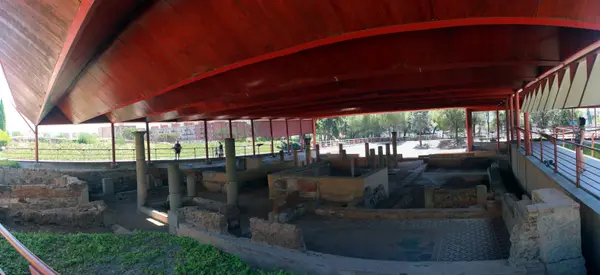
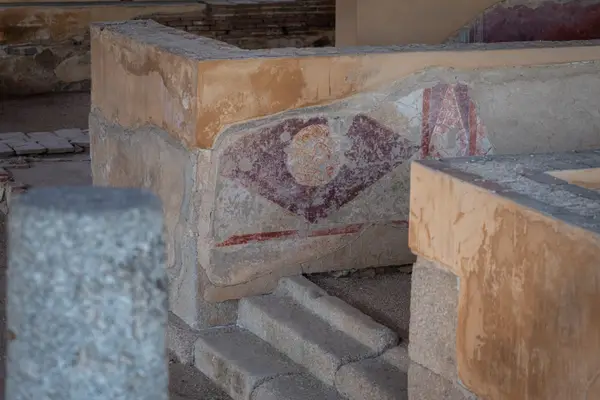
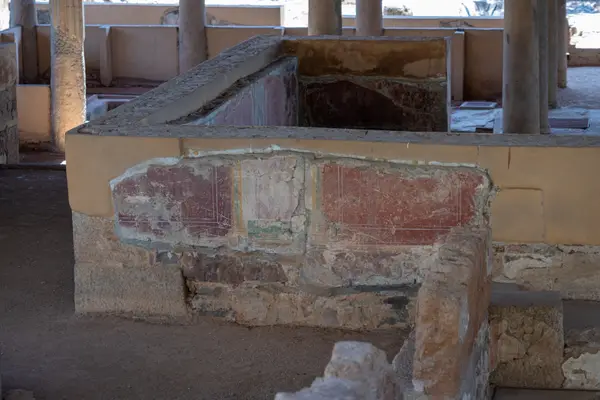
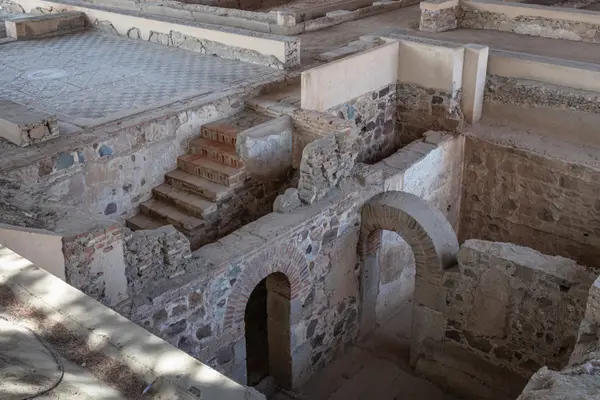
A Roman domus (private town house) of Augusta Emerita, one of the best-preserved grand houses in Roman Hispania. Built in the late 1st or early 2nd century AD outside the walls, on the hill of San Albín, it covers more than 2,000 m² and was lived in, through successive alterations, until its abandonment — placed by some authors in the mid-3rd century after a fire, and by others in the late 4th. It is organised around an atrium with Tuscan-Doric granite columns and two peristyles with gardens (viridaria), pools and an irrigation channel, around which are ranged rooms decorated with wall paintings — candelabra, imitation marbles — and mosaic floors, along with private baths and vaulted underground chambers that speak of the high status of its owners.
- Type
- Villa
- Preservation
- Ruined
- Protection
- Listed · RI-55-0000221
- Listed
- 14/09/1990
- Coordinates
- 38.91119, -6.34110
- Photographs
- 17
What it is and what is left
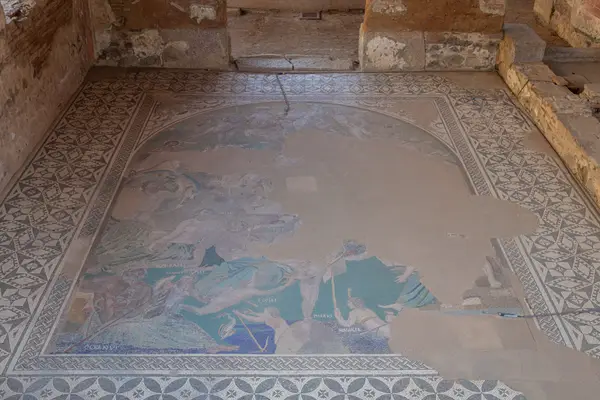
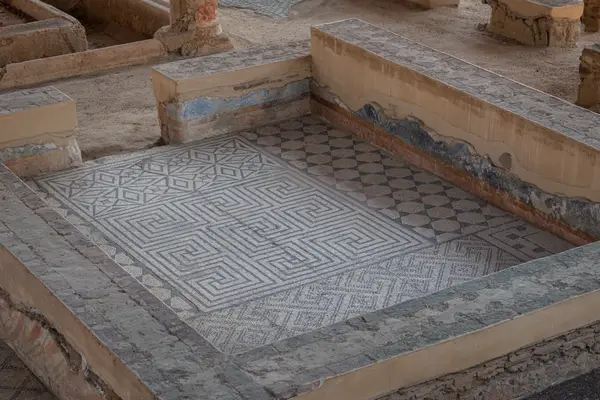
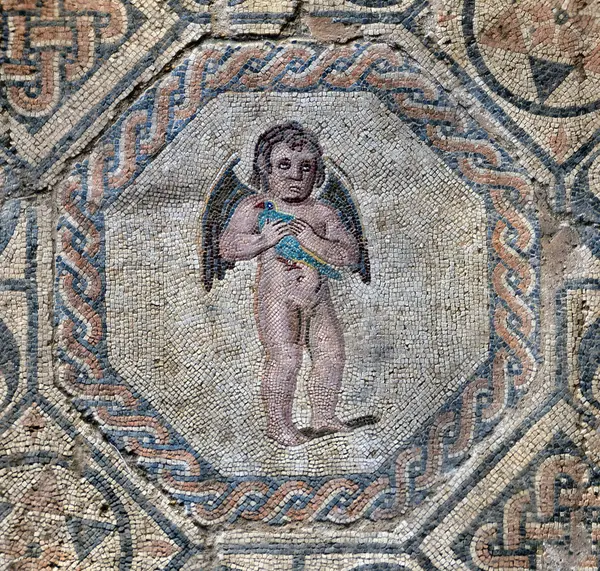
Its most celebrated piece is the Cosmological Mosaic, some 20 m², found on 25 October 1966 during the season directed by Eugenio García Sandoval, begun after the baths turned up by chance in 1964 while a medical surgery was being built. Dated between the second half of the 2nd century and the first half of the 3rd, it shows the cosmos allegorically in three bands (sky, earth and sea), with personifications of the elements, the seasons and the forces of nature around the figure of Eternity (Aeternitas); it is held to be one of the most important mosaics in the Roman world. Other rooms preserve geometric mosaics in black and white.
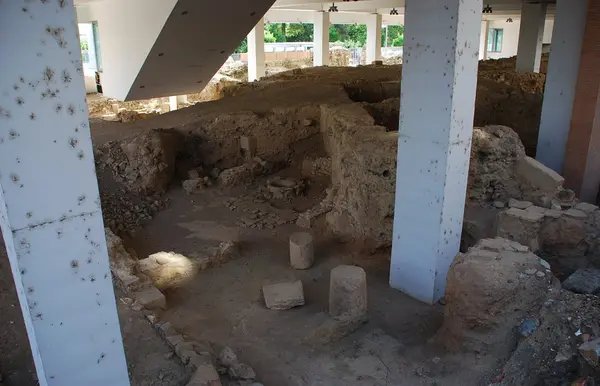
The name «del Mitreo» comes from the sanctuary of the god Mithras found nearby on the hill of San Albín, next to the bullring. The site is roofed and presented as a museum, with a joint ticket for the Columbarios funerary area.
Where the finds are
The Cosmological Mosaic remains where it was found, in the room it was made for, along with the rest of the mosaic floors and the wall paintings of the house.
Portable material recovered in the excavation seasons at the house.
What each period left here
It reads downwards: each band is a period with fabric in this site, newest first, deepest last.
6 facts
8 photographs
Roman
This site has fabric from this period. Mérida has 57 more sites built in the same layer.
See the whole layer →There is no mithraeum in the house. The name comes from remains connected with the cult of Mithras that appeared on the neighbouring plot, the one with the bullring; the house itself was probably that of a high-ranking Roman family.
Consorcio Ciudad Monumental de MéridaThe cosmological mosaic came up in the 1966 season, directed by Eugenio García Sandoval, and lays out across three bands — air, earth and water — an entire picture of the Roman conception of the world and the forces that govern it.
Consorcio Ciudad Monumental de MéridaNobody knows what the mosaic room was for: some authors take it for the tablinum, the master's study, and others think it was the ideal place for a library.
Consorcio Ciudad Monumental de MéridaThe house had underground bedrooms: two vaulted rooms at a lower level than the rest, with a high window, identified as summer cubicula. Going down a few steps was air conditioning in Augusta Emerita.
Casa del Mitreo — WikipediaThe figure presiding over the cosmological mosaic is not a god of the usual sort: it is Aion, Eternity, and beneath him Sky, Earth and Sea divide the field.
Consorcio Ciudad Monumental de MéridaThe colours you see are not quite the original ones: a fire altered part of the mosaic's colour, and the layers show that the same fire caused these rooms to be abandoned in the 3rd century.
Arte Factos — Mosaico cosmológico de Mérida
Below the deepest layer of each site is the ground itself: what has not been excavated yet, or what left nothing built. The catalogue only claims what is documented.
A short walk from here
Straight-line distances, worked out from the coordinates of each site.