Roman circus of Mérida
The Roman circus of Augusta Emerita is the largest of the buildings for public spectacle that the Romans built in Mérida, and one of the largest and most important in the whole Empire. It was built in the early 1st century AD, in the Julio-Claudian period, shortly after the founding of the colony in 25 BC, with alterations documented into the 4th century AD.

- Type
- Circus
- Preservation
- Foundations
- Protection
- Listed · RI-51-0000109
- Listed
- 13/12/1912
- Coordinates
- 38.92003, -6.33213
- Photographs
- 9
What it is and what is left
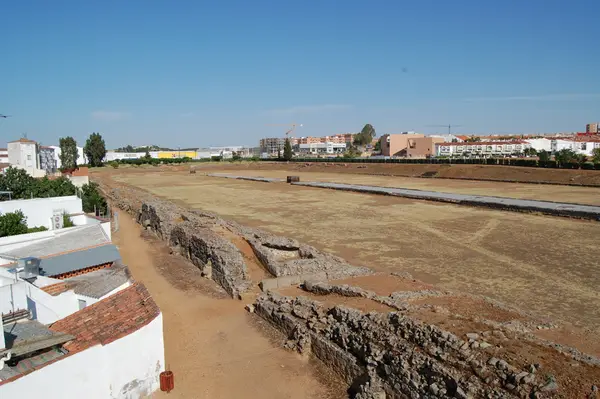
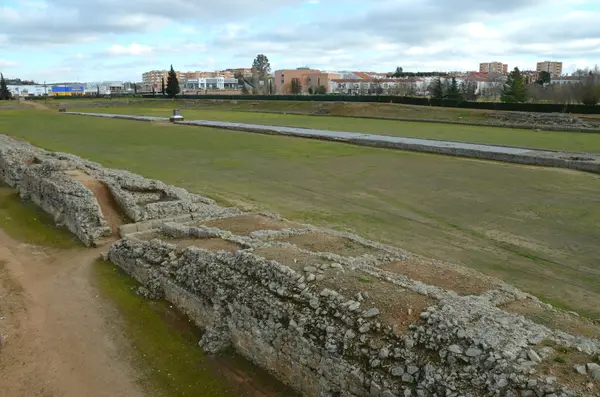
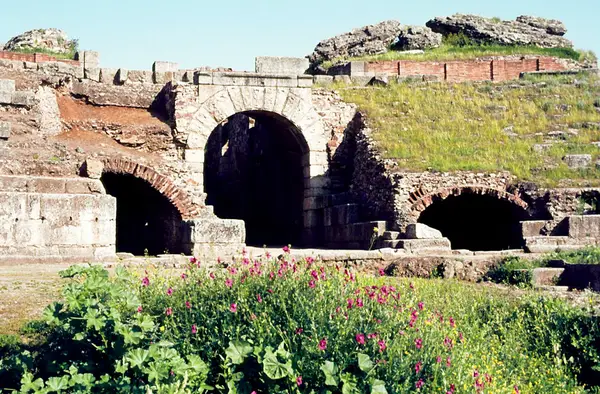
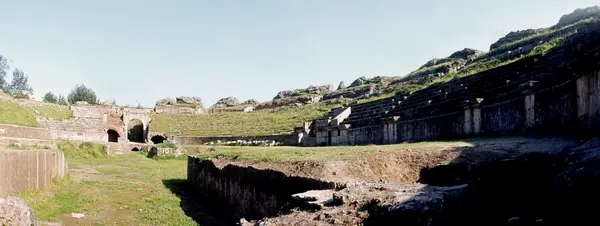
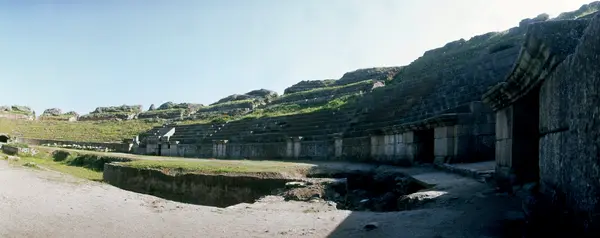
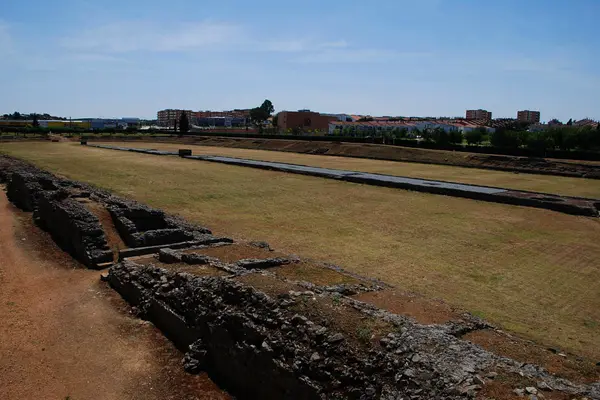
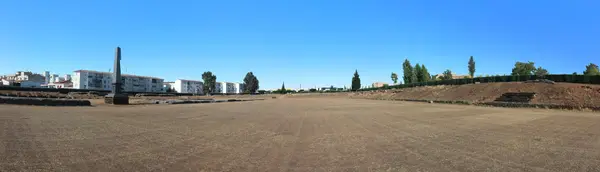
It is rectangular in plan, oriented east–west, with a straight western end holding the twelve carceres (the starting gates for the chariots, six on each side), and a semicircular eastern end (the hemicycle) with the porta pompae, through which the winners left. It measures roughly 440 metres long by 115 wide, with an arena of some 30,000 m². The spina, the central barrier, was 240 metres long and 8.5 metres wide, and was lavishly decorated with obelisks and colossal sculpture. The seating, in ima, media and summa cavea, held some 30,000 spectators.
It was declared a national monument in 1912 and since 1993 has formed part of the Archaeological Ensemble of Mérida, inscribed on the UNESCO World Heritage List. It is one of the few Roman circuses in Hispania whose full plan is still visible.
What each period left here
It reads downwards: each band is a period with fabric in this site, newest first, deepest last.
4 facts
8 photographs
Roman
This site has fabric from this period. Mérida has 57 more sites built in the same layer.
See the whole layer →Until the 1980s the old Madrid–Badajoz road ran across a corner of the circus, crossing the railway on a level crossing at what is now the junction of avenida de Extremadura and avenida Juan Carlos I. An underpass eventually freed the monument.
Televisión Extremeña — Historias de MéridaThe charioteer reckoned the best-paid sportsman in history was from Mérida: Gaius Appuleius Diocles, born here in AD 104, ran 4,257 races, won 1,462 and retired at 42 with 35,863,120 sesterces. He probably started in this circus.
La Brújula Verde — Cayo Apuleyo DioclesRacing went on here long after Christianity became the official religion: the gravestone of the charioteer Sabinianus, found in the basilica of Casa Herrera, is dated to the 6th century and shows he was a Christian who did not give up the trade but had it carved beside his name.
Circo romano de Mérida — WikipediaThe circus was built some 400 metres from the city, outside the wall, simply because it did not fit inside: at 440 m long it was the largest building for spectacle in Augusta Emerita.
Circo romano de Mérida — Wikipedia
Below the deepest layer of each site is the ground itself: what has not been excavated yet, or what left nothing built. The catalogue only claims what is documented.
A short walk from here
Straight-line distances, worked out from the coordinates of each site.
Where this page comes from
- Circo romano de Mérida — Wikipedia es.wikipedia.org
- Circo Romano — Consorcio Ciudad Monumental de Mérida consorciomerida.org