Co-cathedral of Santa María la Mayor
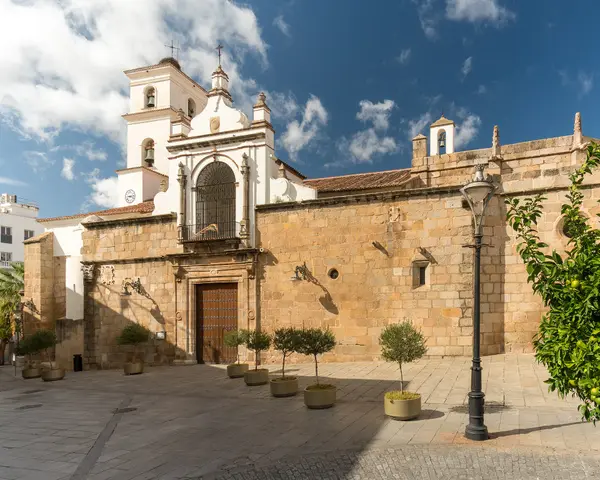
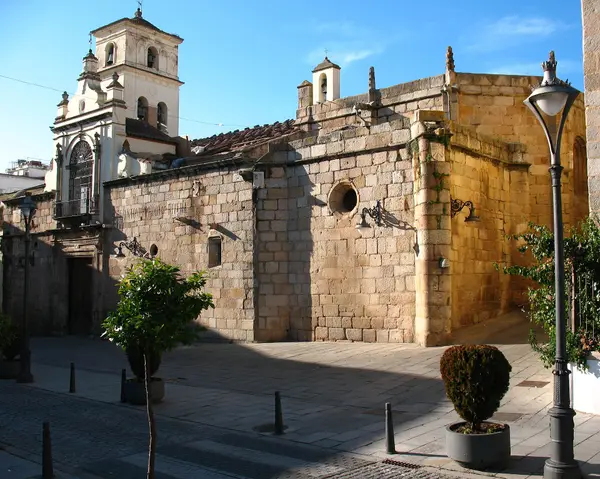
The main church of Mérida, on the plaza de España, raised after the Christian conquest of the 13th century and built largely from reused Roman material: ashlars, column shafts and capitals from the buildings of the colony, visible in its walls and inside. What matters here is less the church than the archaeological record of second use.
- Type
- Church/Chapel
- Preservation
- Standing
- Protection
- —
- Coordinates
- 38.91658, -6.34716
- Photographs
- 2
What it is and what is left
Its position places it in the heart of monumental Augusta Emerita, a few metres from the colonial forum and the Temple of Diana, and research has connected it with the city's episcopal see in Visigothic times: the cathedral of Santa María de Jerusalén mentioned in late antique sources has traditionally been placed in this area, though its exact location is still debated and cannot be taken as settled.
The present building is the result of a long accumulation: medieval fabric, early modern alterations and enlargements, and an interior preserving retables and tombs from the 16th to the 18th century. It shares with the co-cathedral of San Juan Bautista in Badajoz the seat of the archdiocese of Mérida-Badajoz, which is where its title of co-cathedral comes from.
It is a working church: it is visited during service hours and entry does not depend on the city's archaeological monument circuit. It is among the elements cited as part of the archaeological and monumental ensemble of Mérida.
What each period left here
It reads downwards: each band is a period with fabric in this site, newest first, deepest last.
0 facts
0 photographs
Early modern
This site has fabric from this period. Mérida has 8 more sites built in the same layer.
See the whole layer →1 facts
0 photographs
Christian medieval
This site has fabric from this period. Mérida has 8 more sites built in the same layer.
See the whole layer →The church grew by swallowing two others: in 1479 Alonso de Cárdenas, master of the Order of Santiago, ordered it enlarged to make it the main church of Mérida and suppressed the parishes of Santiago and San Andrés, which were annexed to it.
Concatedral de Mérida — Wikipedia0 facts
0 photographs
Late Antique / Visigothic
This site has fabric from this period. Mérida has 7 more sites built in the same layer.
See the whole layer →0 facts
0 photographs
Roman
This site has fabric from this period. Mérida has 57 more sites built in the same layer.
See the whole layer →Below the deepest layer of each site is the ground itself: what has not been excavated yet, or what left nothing built. The catalogue only claims what is documented.
What is told about this site
A legend holds that part of the Treasure of the Temple of Jerusalem was kept here: stones that gave off their own light, enough to light the whole church. In the story Nebuchadnezzar had brought it after sacking Jerusalem, and the Arabs took it from the church in Mérida when they conquered the city.
Extremadura Misteriosa — El tesoro perdido del Templo de JerusalénThe version the chronicles record was told by a cleric of the old metropolitan church: when the Arabs came in they took away a stone set beneath a crucifix that gave such brightness you could pray in the dark by it.
Extremadura Misteriosa — El tesoro perdido del Templo de JerusalénIt regained cathedral rank by a decision of John Paul II: the bull that created the archdiocese of Mérida-Badajoz restored to Santa María the standing of a cathedral, this time shared with the one in Badajoz.
Concatedral de Mérida — WikipediaBeside the chancel, under arcosolia, is the alabaster tomb of Diego de Vera y Mendoza, chancellor to Alonso de Cárdenas, with the nobleman recumbent on his funeral bed. Cárdenas himself and the dukes of La Roca also lie inside.
Concatedral de Mérida — WikipediaThe naves were not always covered in stone: the original roof was Mudéjar carpentry, and the rib vaults you see today came later.
Concatedral de Mérida — WikipediaPhotographs
A short walk from here
Straight-line distances, worked out from the coordinates of each site.
Where this page comes from
- Conjunto Monumental de Mérida — Consorcio de la Ciudad Monumental consorciomerida.org
- Conjunto arqueológico de Mérida — Wikipedia es.wikipedia.org