Baths and ice well
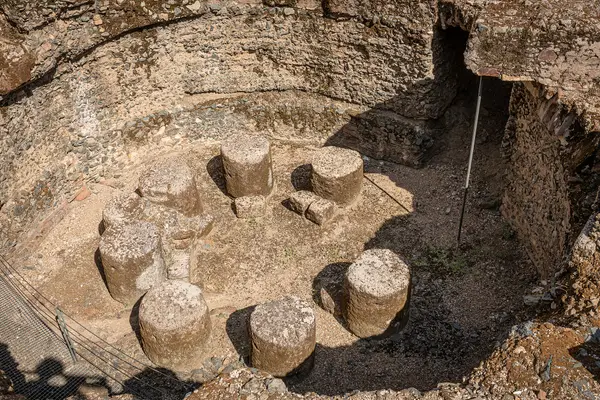
A group of structures preserved at number 7 calle Reyes Huertas, in the eastern suburb of Augusta Emerita, whose original function is still disputed almost a century after they were found. They were first excavated in 1920 and very different readings have been proposed since: Roman public baths, water distribution tanks and, in the early modern period, a snow well or ice house, which is the name by which the place has stuck in the city. That ambiguity is exactly what makes it interesting: it is one of the few monuments in the Mérida ensemble without a settled reading.
- Type
- Baths
- Preservation
- Foundations
- Protection
- Listed · RI-53-0000148
- Coordinates
- 38.91832, -6.33942
- Photographs
- 1
What it is and what is left
The sequence does not end in Roman times. Above the structures, Visigothic houses are recorded and, over those, an Islamic burial ground, so the plot sums up in a few square metres the layering of the four Méridas: Roman, Visigothic, Islamic and early modern.
The remains lie below street level and can be seen from the public street at any time, with an information panel, with no enclosure or opening hours. They are a few metres from the Casa del Anfiteatro and the Roman amphitheatre, in what was one of the best-known areas of extramural expansion of the colony. Part of the Archaeological Ensemble of Mérida, World Heritage (UNESCO, 1993).
It is an example of the extraordinary density of baths in the city: more than fifty bath complexes have been excavated in Mérida, the highest figure in all of Hispania.
Where the finds are
Material from the early excavations in Mérida entered the museum's holdings. No specific published inventory for this plot has been found.
What each period left here
It reads downwards: each band is a period with fabric in this site, newest first, deepest last.
0 facts
0 photographs
Early modern
This site has fabric from this period. Mérida has 8 more sites built in the same layer.
See the whole layer →0 facts
0 photographs
Islamic (al-Andalus)
This site has fabric from this period. Mérida has 4 more sites built in the same layer.
See the whole layer →0 facts
0 photographs
Late Antique / Visigothic
This site has fabric from this period. Mérida has 7 more sites built in the same layer.
See the whole layer →0 facts
0 photographs
Roman
This site has fabric from this period. Mérida has 57 more sites built in the same layer.
See the whole layer →Below the deepest layer of each site is the ground itself: what has not been excavated yet, or what left nothing built. The catalogue only claims what is documented.
What is told about this site
Few monuments have been so many things on paper: these structures have been proposed as public baths, as the tepidarium of a bath suite (Almagro, 1961), as the baptistery of a mystery religion whose rites were kept hidden (Broëns, 1963), as a glass or oil-lamp factory, as a tank on a branch of the San Lázaro aqueduct, and as an industrial complex for snow and ice.
M. Alba, «Los restos arqueológicos de la calle Reyes Huertas: ¿pozos de nieve de época romana?» (Mérida excav. arqueol. 9)The snow-well idea was born of a coincidence: in 1990 the archaeologist Miguel Alba came across the 16th-century snow well of Salvatierra de los Barros while studying traditional pottery, and it reminded him of these structures. If he was right, they would be the first snow wells identified anywhere in the Roman world.
M. Alba, «¿Pozos de nieve de época romana?» (Mérida excav. arqueol. 9)The paradox of the thing: it does not snow in Mérida. Three snowfalls are remembered in the whole 20th century, so the snow would have been carted in from far away — and that is precisely what made it a luxury item worth building an industry around.
M. Alba, «¿Pozos de nieve de época romana?» (Mérida excav. arqueol. 9)Photographs
A short walk from here
Straight-line distances, worked out from the coordinates of each site.
Where this page comes from
- Termas/Pozo de la Nieve — Consorcio de la Ciudad Monumental de Mérida consorciomerida.org
- Termas/Pozo de la Nieve (Mérida) — Observatorio Extremeño de la Cultura observaculturaextremadura.es