Los Milagros aqueduct
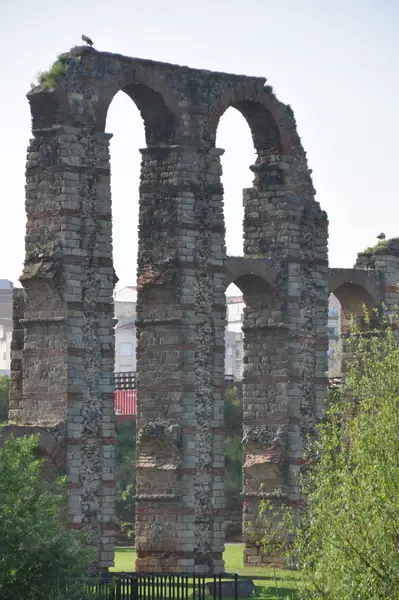
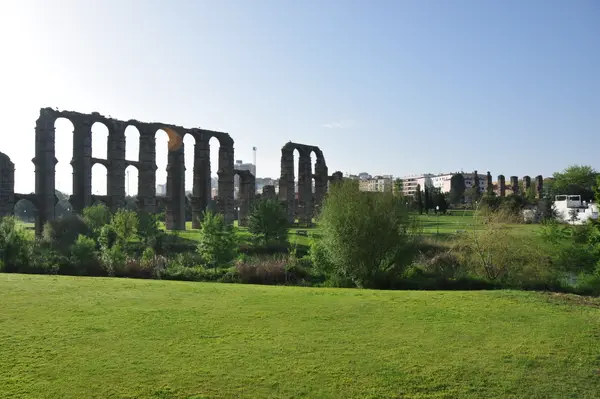
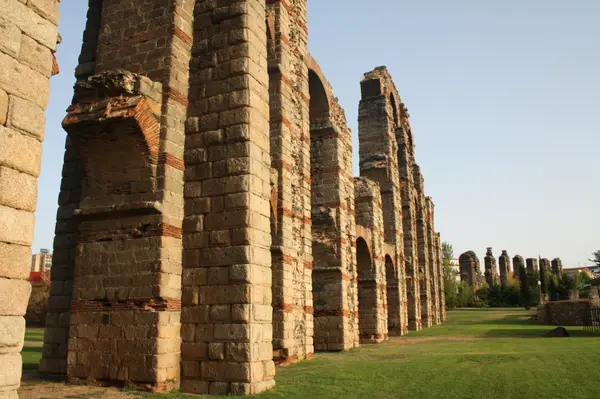
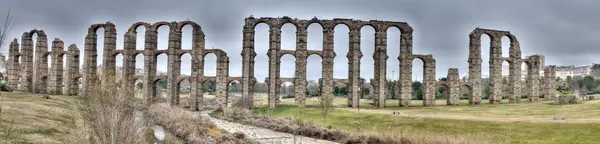
The Los Milagros aqueduct is one of the most imposing Roman monuments in Hispania, part of the Archaeological Ensemble of Mérida declared a UNESCO World Heritage site in 1993. Built to supply the Roman colony of Augusta Emerita (today's Mérida, capital of Lusitania), it brought water from the Proserpina reservoir, some 5 km to the north-west, to a castellum aquae on calle Calvario, from where it was distributed through the town.
- Type
- Aqueduct
- Preservation
- Standing
- Protection
- Listed · RI-51-0000112
- Listed
- 13/12/1912
- Coordinates
- 38.92225, -6.34840
- Photographs
- 18
What it is and what is left
Its date is disputed: the traditional view places it in the 1st century AD, possibly in the Augustan period (around 25 BC), while thermoluminescence studies by the Universidad Autónoma de Madrid argue for a construction no earlier than the 4th century AD, tying it to the rebuilding of the city under Diocletian, when Mérida became capital of the Dioecesis Hispaniarum.
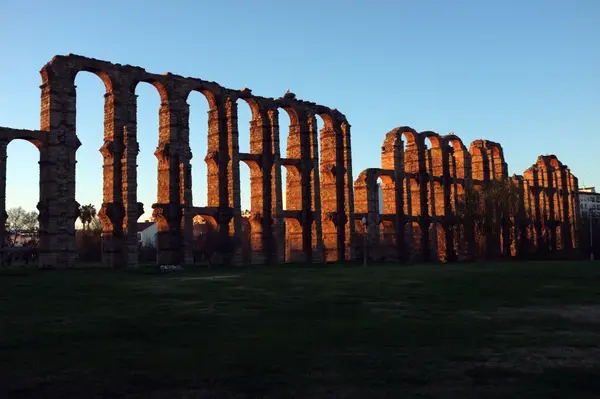
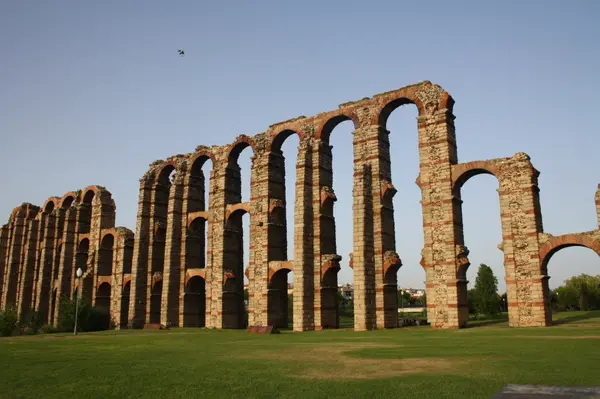
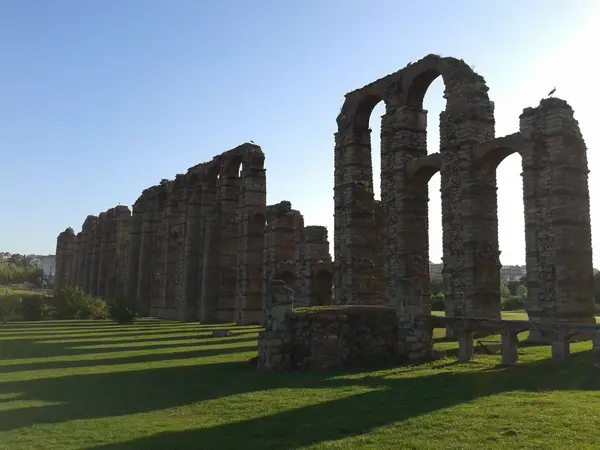
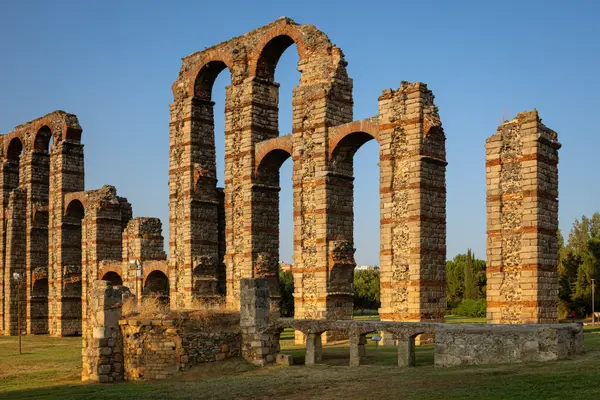
The surviving stretch, about 830 metres long, has 38 piers carrying a double arcade that reaches 25 metres in height as it crosses the valley of the river Albarregas. The piers, 2.5 × 2.5 m in section, are built in opus mixtum: a core of opus caementicium faced with granite ashlars alternating with courses of red brick, the technique that gives the whole thing its two-tone look. The structure also includes an underground stretch and a piscina limaria, a settling tank for the water.
Listed as a national monument since 1912, the aqueduct still stands, though in a ruinous state. It is free to visit, and lit at night.
What each period left here
It reads downwards: each band is a period with fabric in this site, newest first, deepest last.
16 facts
8 photographs
Roman
This site has fabric from this period. Mérida has 57 more sites built in the same layer.
See the whole layer →It is not called «de los Milagros» — of the Miracles — for any religious wonder: the name comes from local amazement that such a mass should still be standing century after century, to the point of taking it for a miracle.
Turismo de ExtremaduraThe name was literal, and it was counted one by one: each pier was called «a miracle». Bernabé Moreno de Vargas records it in his History of the city of Mérida (1633), adding that people credited the work to the emperor Trajan.
Extremadura: caminos de cultura — El acueducto de los MilagrosAntonio Ponz, in his Viage de España (1784), left the count done: thirty-seven piers standing, «los Milagros». It is the oldest surviving census of the monument.
Extremadura: caminos de cultura — El acueducto de los MilagrosThere are phalluses carved into the ashlars. Four have been identified: a double one — two erect penises joined — on the south face of the eighth pier on the right bank of the Albarregas, and three single ones, horizontal with the glans pointing right, on the fifteenth, sixteenth and eighteenth piers on the left bank.
Extremadura: caminos de cultura — Falos del acueducto de los MilagrosThey were not a stonemason's joke: the phallus, the Roman fascinus, was also set in streets, floors and public works as a charm for the community, to keep the evil eye out of Emerita Augusta and draw in prosperity at the same time.
Extremadura: caminos de cultura — Falos del acueducto de los MilagrosIn the 18th century a whole «miracle» was pulled down to reuse its stone in rebuilding the hermitage of the Santísima Trinidad: time did not take it, it was dismantled to build something else.
GOING (Colegio de Ingenieros de Caminos) — Acueducto de los MilagrosThat the water came from Proserpina, as every guidebook repeats, is under dispute. Santiago Feijóo, of the Consorcio de la Ciudad Monumental, has traced remains of the conduit beyond the dam and argues that the original height of the dam wall does not reach that of the aqueduct: the two cannot have worked together.
Embalse de Proserpina — WikipediaOn that reading, the aqueduct was built to bring clean water from local springs, and Mérida's two dams would be far later — Visigothic or Islamic — raised when the Roman conduits had already been abandoned, to drive mills, water livestock or wash wool.
Celtiberia.net — «La presa de Proserpina no es romana»In 2019 a study presented at the Universidad Autónoma de Madrid concluded that the aqueduct was not Roman but Visigothic, and the city rounded on it: the dating rested on the thermoluminescence of a single brick, which gave the year 290 with a margin of error of ±106 years.
El Español — «El acueducto de Mérida no es romano»: la polémica que indigna a la ciudadThe arguments against are stratigraphic: there is a 1st-century mausoleum built against the aqueduct — which therefore already existed — and the channel is found silted up in the 4th and 5th centuries, exactly when the study claimed it was being built.
eldiario.es — Un estudio basado en un ladrillo «descubre» que el acueducto es visigodoIt is impressive from outside, but the water had very little room: the specus, the channel, was only some 56 cm wide, lined with opus signinum. Twenty-five metres of masonry for a narrow spout.
GOING (Colegio de Ingenieros de Caminos) — Acueducto de los MilagrosA Visigothic-period repair has been identified on one of the piers, between the settling tank and the Albarregas crossing: somebody went on maintaining it when the Empire was no longer there.
GOING (Colegio de Ingenieros de Caminos) — Acueducto de los MilagrosThe stork nests up top are not light: a new one weighs between 50 and 100 kg, over the years it reaches 250, and the record on file is 500 kg. On top of a two-thousand-year-old Roman arcade, that is an engineering problem.
Extremadura7días — Los Milagros de las cigüeñasSo in 1991 local ornithologists put up five artificial nests of vine shoots in deliberately chosen spots: on the piers, never on the brick arches, which are the weakest part of the conduit. That same year five chicks fledged.
Extremadura7días — Los Milagros de las cigüeñasThe colony is shrinking: in 2024 only four pairs bred, and several nests disappeared during maintenance work on the aqueduct.
Extremadura7días — Los Milagros de las cigüeñasAlternating courses of granite and red brick was not only structural: that two-colour play has been pointed to as one of the sources of Hispano-Muslim caliphal art.
Turismo de Extremadura
Below the deepest layer of each site is the ground itself: what has not been excavated yet, or what left nothing built. The catalogue only claims what is documented.
A short walk from here
Straight-line distances, worked out from the coordinates of each site.
Where this page comes from
- Acueducto de Los Milagros — Consorcio Ciudad Monumental de Mérida consorciomerida.org
- Acueducto de los Milagros — Wikipedia en.wikipedia.org
- Tramo subterráneo del acueducto de los Milagros — Feijoo S. (Consorcio Mérida, Memoria 2006-2008) biblioteca.consorciomerida.org