Early Christian basilica of Casa Herrera
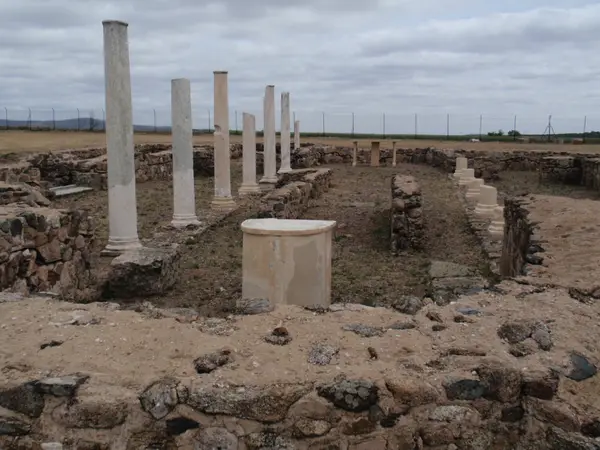
An Early Christian and Visigothic basilica standing on a low hill some seven kilometres north of Mérida, at the place called Casa Herrera, one of the best-known late antique places of worship in the peninsula. The church, with three aisles and apses at both ends, was built around the year 500; in the late 6th century the baptistery and other rooms were added.
- Type
- Church/Chapel
- Preservation
- Foundations
- Protection
- Inventoried · Nivel B-1
- Coordinates
- 38.96862, -6.28231
- Photographs
- 1
What it is and what is left
Its most singular feature is the baptismal font for immersion, of which only about ten are known in the Iberian Peninsula. The excavation produced numerous decorative fragments, funerary inscriptions and sarcophagi, as befits a building that also served as privileged burial ground. In a later period the place was used for Muslim worship.
The monument was discovered in 1943 by J. de C. Serra Ràfols. In 1968, commissioned by the German Archaeological Institute and directed by Thilo Ulbert, the ruins were cleared and the baptistery and part of the nave examined; the 1971 and 1972 seasons were directed jointly by Ulbert and Luis Caballero, and their report was published in 1976 in the Excavaciones Arqueológicas en España series. In 2007 T. Cordero and I. Sastre excavated again to establish the continuity of human settlement, which runs from the late Empire to the 8th century.
On the surface there are also building and pottery remains of a rural settlement, and stretches of water channel nearby: the place lies at the catchment head of the Las Tomas–Rabo de Buey aqueduct, which took water from the springs of Las Tomas, Valhondo and Casa Herrera. The plan of the basilica is consolidated and legible at ground level. Location approximate.
What each period left here
It reads downwards: each band is a period with fabric in this site, newest first, deepest last.
0 facts
0 photographs
Islamic (al-Andalus)
This site has fabric from this period. Mérida has 4 more sites built in the same layer.
See the whole layer →0 facts
0 photographs
Late Antique / Visigothic
This site has fabric from this period. Mérida has 7 more sites built in the same layer.
See the whole layer →0 facts
0 photographs
Roman
This site has fabric from this period. Mérida has 57 more sites built in the same layer.
See the whole layer →Below the deepest layer of each site is the ground itself: what has not been excavated yet, or what left nothing built. The catalogue only claims what is documented.
What is told about this site
This is where the gravestone of the charioteer Sabinianus came from, a 6th-century Christian who did not give up his trade as a chariot driver and had it carved beside his name: it is the proof that racing went on in the circus of Mérida in Visigothic times. It turned up in the 1972 season, reused as the cover of grave number 53.
Circo romano de Mérida — WikipediaThe two facing apses, one at the head and one at the foot, are no local whim: they link the basilica to a type of church widespread in North Africa.
Consorcio Ciudad Monumental de MéridaThere are graffiti in Arabic on its walls, among the oldest Arabic inscriptions in the Iberian Peninsula: for the 9th century, examples are barely known elsewhere. Carmen Barceló studied them in 2002.
C. Barceló, «Escritos árabes en la basílica paleocristiana de Casa Herrera» (Madrider Mitteilungen)The wording of those graffiti is that of recent converts, and it has been suggested they were written by detainees who failed to pay their taxes and were shut in here: the deconsecrated basilica would have served as a temporary prison.
C. Barceló, «Escritos árabes en la basílica paleocristiana de Casa Herrera» (Madrider Mitteilungen)The size of the plan and the richness of its decoration do not fit a village: they point to a religious centre of reference for a population very thinly spread across the countryside, and its use for worship and burial went on for close to four centuries.
Ruta de la Plata — Basílica de Casa HerreraPhotographs
A short walk from here
Straight-line distances, worked out from the coordinates of each site.