Forum of Augusta Emerita
The colonial forum of Augusta Emerita (today's Mérida) was the civic, political and religious centre of the Roman colony founded in 25 BC by Octavian Augustus for veterans of the Cantabrian Wars. It stretched between today's calles San José and Los Maestros, and between the Temple of Diana and calle Viñeros, around the meeting of the city's cardo and decumanus maximus.
- Type
- Forum
- Preservation
- Ruined
- Protection
- Listed · RI-53-0000148
- Listed
- 08/02/1973
- Coordinates
- 38.91684, -6.34303
- Photographs
- 11
What it is and what is left
The forum was presided over by the so-called Temple of Diana, a hexastyle peripteral temple built in granite, standing on a podium 3.25 m high and measuring 32.80 × 21.90 m. Although popularly known as the Temple of Diana, it was dedicated to the imperial cult. The sacred precinct (temenos) was a closed rectangular space with two ritual pools flanking the temple. The complex was completed by porticoes, a basilica, baths and, on its western wing, a half-underground gallery (a cryptoporticus or public store).
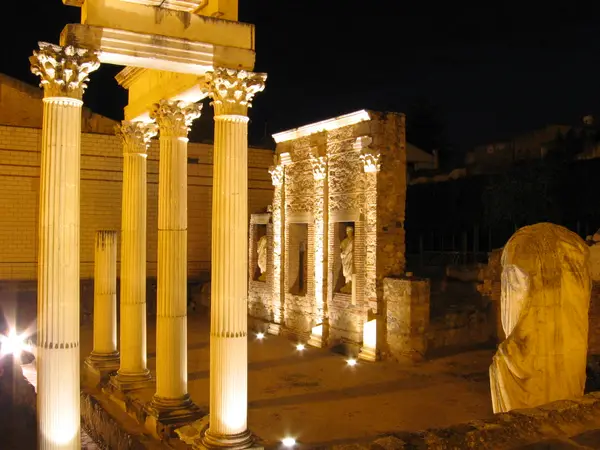
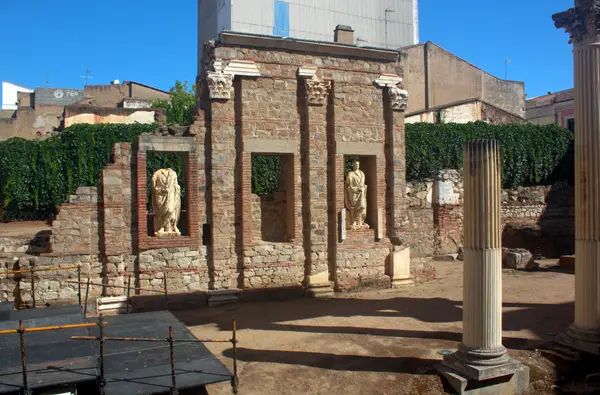
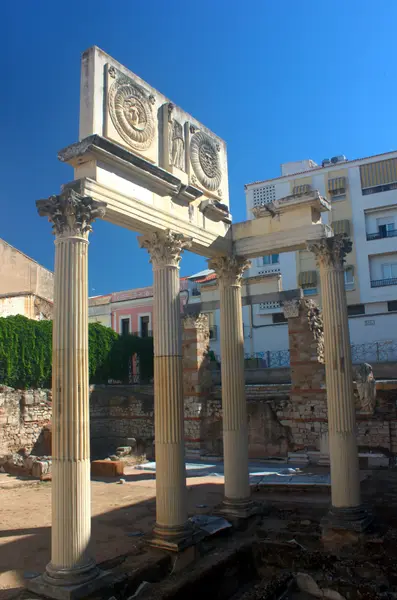
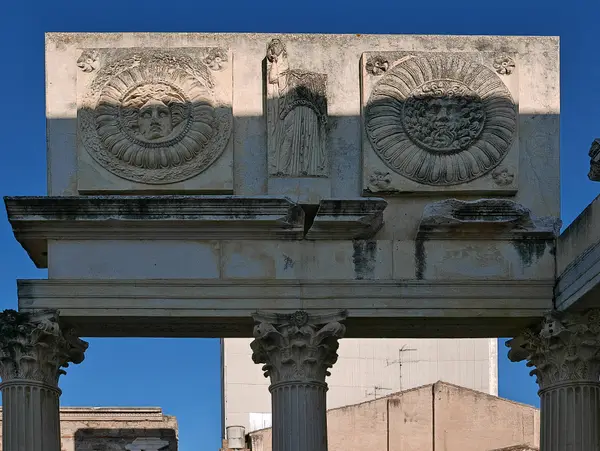
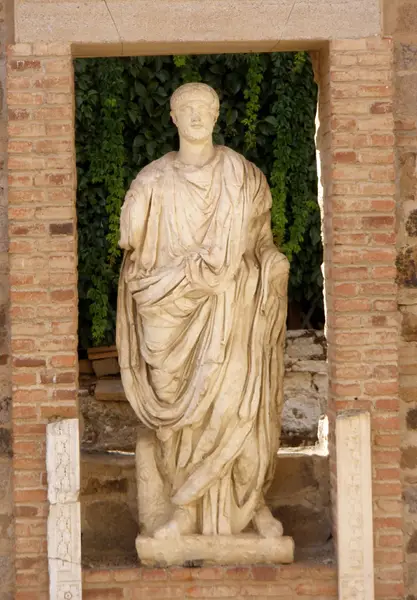
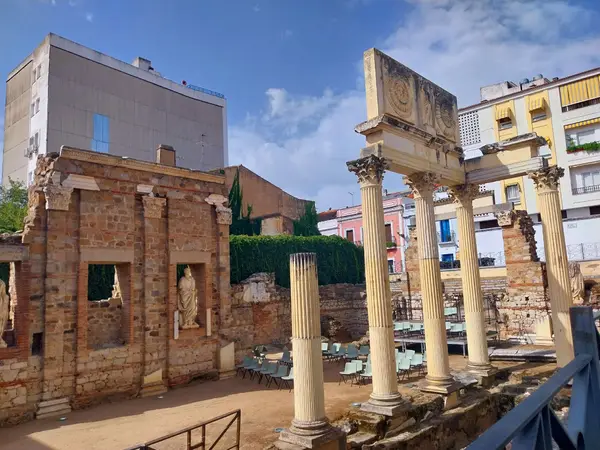
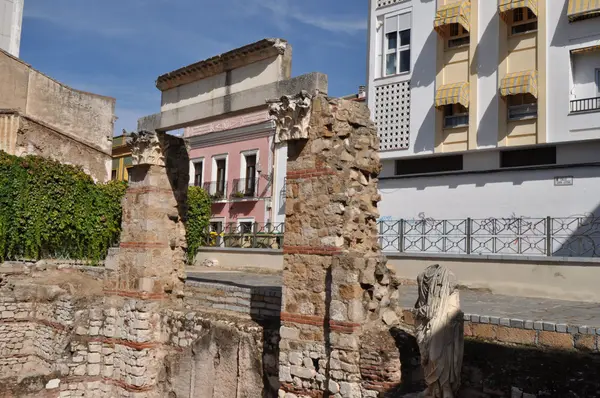
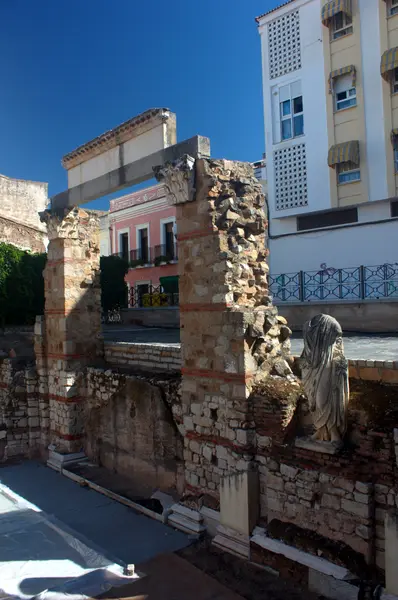
The complex expanded greatly eastwards in the Flavian period (second half of the 1st century AD). What you visit on the ground today is above all the corner of the Forum Portico, of Julio-Claudian date, on calle Sagasta, behind the Temple of Diana: Corinthian columns carrying an attic with clipei, medallions alternating heads of Jupiter Ammon and Medusa with caryatids bearing kraters, in imitation of the Forum of Augustus in Rome. The closing wall preserves the great niches that held statues of the imperial family and of gods and myths tied to the house of Augustus: a programme of dynastic propaganda, not mere decoration. Worth knowing: the sculptural elements installed on the monument are reproductions; the originals are in the National Museum of Roman Art. The forum's public baths were also recorded in the same space. Free to see from the street, with no enclosure or opening hours.
It forms part of the Archaeological Ensemble of Mérida, declared a UNESCO World Heritage site in 1993.
Where the finds are
The original clipei with heads of Jupiter Ammon and Medusa, caryatids bearing kraters, and architectural elements from the Forum Portico. What is installed on the monument today are reproductions.
What each period left here
It reads downwards: each band is a period with fabric in this site, newest first, deepest last.
3 facts
8 photographs
Roman
This site has fabric from this period. Mérida has 57 more sites built in the same layer.
See the whole layer →The portico was not vaguely inspired by Rome: it was made in the image of the Forum of Augustus, with the same propaganda programme, and its walls carried niches with statues of the imperial family and of the gods and myths tied to the history of Rome and to the house of Augustus.
MNAR — Decoración del Pórtico del ForoIn the attic, medallions with heads of Jupiter-Ammon and Medusa alternated, flanked by caryatids bearing kraters. The originals are on display in the National Museum of Roman Art.
MNAR — Decoración del Pórtico del ForoThe forum was closed off from below as well: the whole complex was ringed by a cryptoporticus, an underground porticoed gallery that bounded it on the north side.
Consorcio Ciudad Monumental de Mérida
Below the deepest layer of each site is the ground itself: what has not been excavated yet, or what left nothing built. The catalogue only claims what is documented.
A short walk from here
Straight-line distances, worked out from the coordinates of each site.
Where this page comes from
- Foro romano de Mérida - Wikipedia es.wikipedia.org
- Foros de Mérida - Arte Romano (UCM) arteromanoforosucm.wordpress.com
- Templo de Diana - Consorcio Ciudad Monumental de Mérida consorciomerida.org
- Pórtico del Foro — Consorcio de la Ciudad Monumental de Mérida consorciomerida.org
- El Pórtico del Foro y las termas públicas del foro — Guía del Consorcio de Mérida guia.consorciomerida.org
- Pórtico del Foro Municipal de Augusta Emerita — ArteViajero arteviajero.com